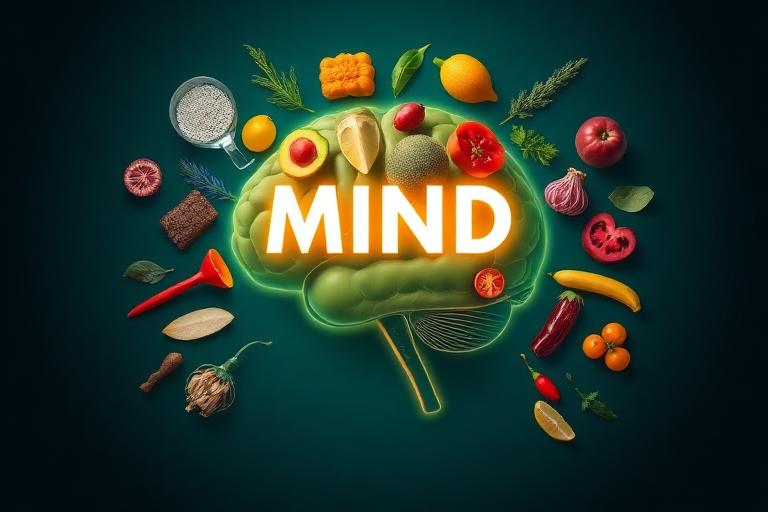
MIND Diet: what science shows about brain protection
The search for dietary strategies that protect the brain against aging and neurodegeneration has gained enormous attention from the scientific community over the past two decades. Among the most promising approaches, the MIND Diet (Mediterranean-DASH Intervention for Neurodegenerative Delay) stands out as a hybrid model combining principles from the Mediterranean and DASH diets, with specific focus on brain health-associated foods.
The study that changed the conversation
The seminal work by Morris et al. (2015), published in Alzheimer's & Dementia, followed 923 participants aged 58-98 over 4.5 years. Results were impressive: those with highest MIND Diet adherence showed a 53% reduction in Alzheimer's risk, even after adjusting for confounding factors like age, sex, education, physical activity, and genetics (APOE ε4).
The most interesting aspect is that even moderate adherence — not necessarily perfect — showed significant benefits, with a 35% risk reduction. This is clinically relevant because it suggests that incremental, rather than radical, dietary changes can offer substantial neuroprotection.
The 15 components of the MIND Diet
The MIND Diet is structured around 10 neuroprotective food groups and 5 groups to limit:
Neuroprotective foods (recommended intake):
- Leafy greens (6+ servings/week) — rich in folate, lutein, and vitamin K
- Other vegetables (1+ serving/day) — variety of phytonutrients
- Berries (2+ servings/week) — anthocyanins with anti-inflammatory action
- Nuts (5+ servings/week) — vitamin E and fatty acids
- Olive oil (primary fat source) — polyphenols and oleocanthal
- Whole grains (3+ servings/day) — fiber and B vitamins
- Fish (1+ serving/week) — DHA and EPA
- Legumes (3+ servings/week) — plant protein and fiber
- Poultry (2+ servings/week) — lean protein
- Wine (1 glass/day, optional) — resveratrol
Foods to limit:
- Red meat (<4 servings/week)
- Butter/margarine (<1 tablespoon/day)
- Cheese (<1 serving/week)
- Pastries and sweets (<5 servings/week)
- Fast food/fried food (<1 serving/week)
Neuroprotective mechanisms
MIND Diet benefits operate through multiple biological mechanisms:
1. Oxidative stress reduction: Antioxidants in berries (anthocyanins), leafy greens (lutein, zeaxanthin), and olive oil (oleocanthal) neutralize free radicals that damage neurons. The brain, despite representing only 2% of body weight, consumes 20% of oxygen, making it particularly vulnerable to oxidative damage.
2. Neuroinflammation control: The combination of omega-3 (fish), polyphenols (olive oil), and flavonoids (berries) reduces pro-inflammatory cytokines like TNF-α and IL-6, which are directly implicated in Alzheimer's progression.
3. Synaptic integrity support: DHA, a structural component of neuronal membranes, is essential for synaptic plasticity and neurotransmission. Choline, present in eggs and legumes, is a precursor of acetylcholine, a key neurotransmitter in memory formation.
4. Epigenetic modulation: Nutrients like folate, vitamin B12, and polyphenols influence DNA methylation patterns, potentially silencing genes associated with neurodegeneration.
The NEJM Randomized Controlled Trial (RCT)
In 2023, Barnes et al. published in the New England Journal of Medicine the results of the first MIND Diet RCT with 604 participants without cognitive impairment. After 3 years, both groups (MIND and calorie-restricted control) showed cognitive improvements, with no significant difference between them.
This does not invalidate the MIND Diet, but brings important nuances:
- The control group also improved dietary quality
- 3 years may be insufficient to detect neuroprotection differences
- Previous observational studies had longer follow-up (4.5-12 years)
- RCT adherence was partial, as expected in dietary intervention studies
How I apply it in clinical practice
In my experience with Brazilian patients in the US, MIND Diet adaptation is especially effective when personalized to individual routines:
For executives with busy schedules:
- Morning smoothie with berries + spinach + nuts + whey (3-min prep)
- Accessible Mediterranean lunches (salmon salads, chickpea bowls)
- Nuts and berries as between-meeting snacks
- Omega-3 supplementation (1-2g EPA+DHA/day) when fish intake is insufficient
Monitoring:
- Baseline cognitive assessment (MoCA or similar)
- Inflammatory markers (high-sensitivity CRP)
- Fatty acid profile (Omega-3 Index)
Conclusion
The MIND Diet represents one of the most robust nutritional strategies for neuroprotection. While the 2023 RCT didn't show superiority over an active control at 3 years, the body of observational evidence remains strong. Most importantly, its components — vegetables, berries, fish, nuts, and olive oil — have broadly documented benefits for cardiovascular, metabolic, and brain health, making it a smart choice regardless of the primary outcome in a single study.
This is one of the core principles I apply in my neuronutrition clinical protocols.
Scientific References
Murilo Toscano · CRN-6 26497 · About the author ·